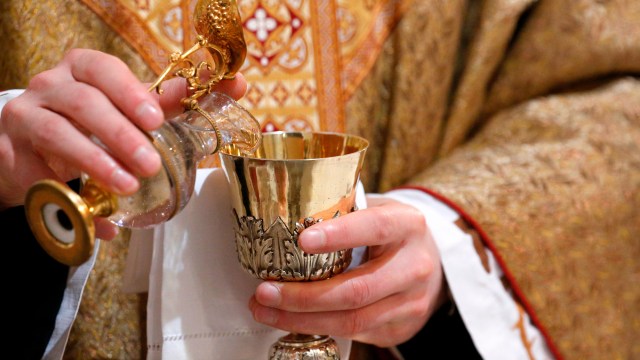
The liturgical gesture (of Jewish origin) of adding water to the wine is primarily practical. However, the accompanying prayer gives it a symbolic meaning.
As the French saying goes, “Water spoils wine, wine improves water.” But couldn’t we say that this also makes good theological sense? If water is the sign of humanity and wine that of divinity, the former is indeed called upon, through Christ’s sacrifice, to unite with the latter. St. Ireneaus said, “He who was the Son of God became the Son of man that man … might become the son of God.” The opposite — when humanity strays from its vocation as son of the Father by wasting his gifts — is sin.
A silent prayer
This central reality of Christian life is recalled at every Mass by a discreet gesture from the priest or deacon. During the offertory, as he dilutes the wine intended for consecration with a small amount of water, the minister prays under his breath:
By the mystery of this water and wine, may we come to share in the divinity of Christ, who humbled himself to share in our humanity.
At the heart of the Eucharistic sacrifice, this prayer reminds us that the faithful associate themselves with this sacrifice at the same time as they wish to be conformed to the life of Christ the Redeemer.
Jaime Garcia M | Shutterstock
The two natures of Christ offered on the Cross
The archbishop emeritus of Toulouse, Robert Le Gall, explains in his Dictionary of Liturgy that putting water into wine is first and foremost a very practical gesture originating in Jewish liturgy. On feast days, the wine — often very strong in those arid, sun-drenched lands — is diluted before drinking. The origin of this practice is a reminder that the institution of the Eucharist is rooted in the festive meals of the people of Israel.
Beyond the symbolism evoked above of the Eucharist joining our humanity to Christ’s divinity, the cup also symbolizes the union of the two natures (human and divine) in the person of Christ. During his offering on the Cross, his two natures truly give themselves out of love. This love was already manifested on Golgotha by the water and blood that gushed from the pierced side, and which are also symbolized in the chalice filled with wine to which the minister adds a dash of water.