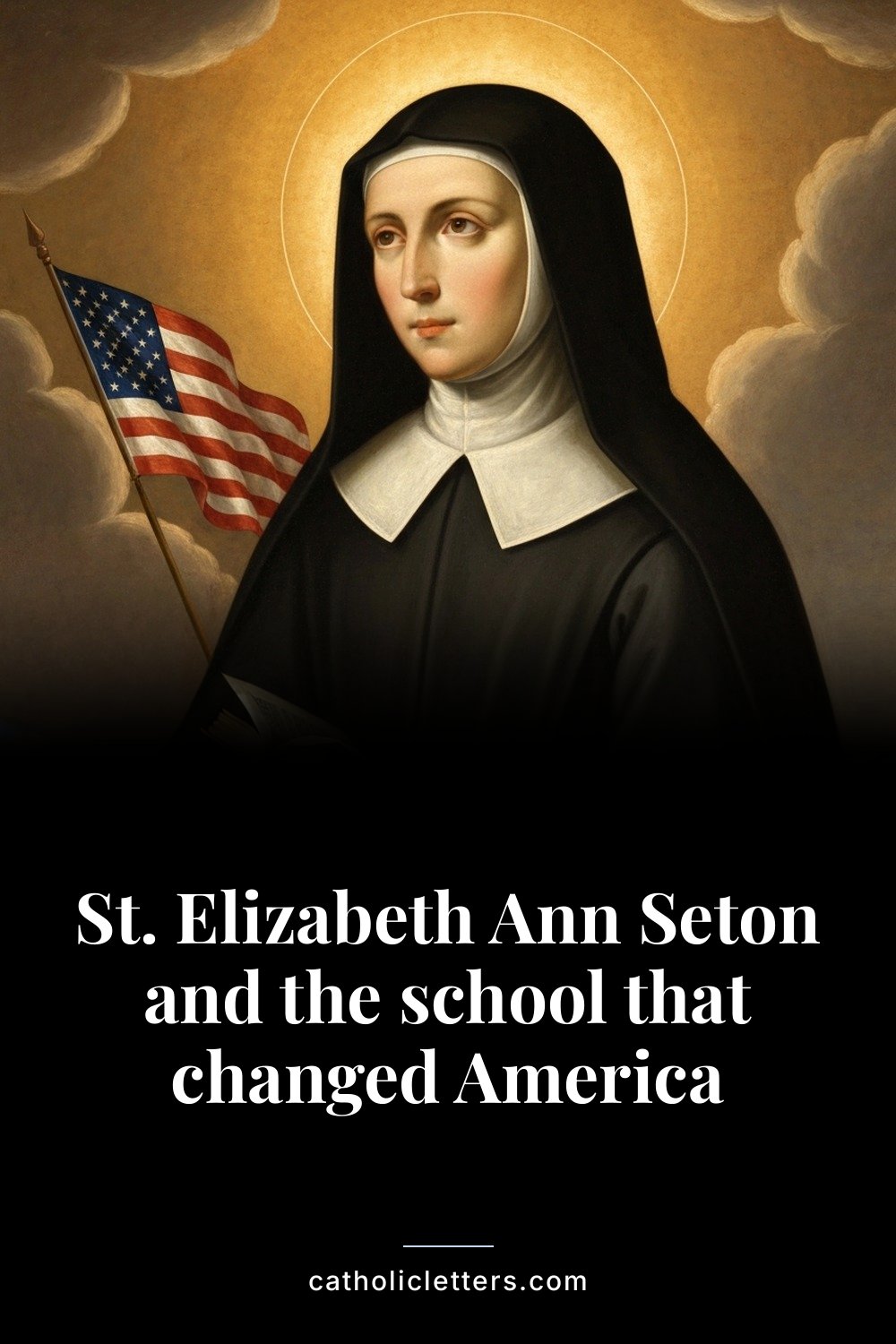
Today the Church honors St. Elizabeth Ann Seton, the first person born in the United States to be canonized. Her memorial falls outside the Easter season this year, giving us space to look at the convert widow who became the mother of Catholic education in America.
Who Elizabeth Ann Seton was
Born Elizabeth Ann Bayley in New York City on August 28, 1774, she grew up Episcopalian in a prominent family. She married William Seton, a wealthy merchant, in 1794, and they had five children. When William’s business failed and his health collapsed, they sailed to Italy in 1803 seeking recovery. He died there of tuberculosis at age thirty-five, leaving Elizabeth a widow at twenty-nine.
In Italy, staying with Catholic friends, she encountered the Real Presence in the Eucharist. The witness of her hosts and her reading of Scripture drew her toward Rome. She converted in 1805, facing immediate rejection from family and New York society. She lost financial support, social standing, and access to her own children was threatened by relatives who saw Catholicism as dangerous.
She opened a school for girls in Baltimore in 1808 at the invitation of a Sulpician priest. Within a year, other women joined her. In 1809 she took vows and founded the Sisters of Charity of St. Joseph’s, adapting the rule of St. Vincent de Paul for American conditions. She died of tuberculosis on January 4, 1821, at age forty-six, having established the foundation for the American parochial school system.
What she’s known for
Elizabeth Ann Seton made Catholic education accessible to ordinary Americans. Before her schools, Catholic education in the United States was sparse and expensive. Her Sisters of Charity taught poor children for free and established orphanages. By her death, her order ran schools in multiple states. The black habit she wore was a widow’s dress, not an elaborate religious costume, because she believed religious life should be practical, not ostentatious.
She wrote constantly: letters, journals, retreat notes, translations of spiritual works. Her spirituality centered on the Eucharist and Scripture, especially the Psalms. She faced crushing losses (her husband, two daughters, constant poverty, physical pain) without becoming bitter. Her letters show someone who learned to say “The will of God” not as resignation but as fierce trust.
For today
If you’re facing a loss that feels like it closed every door, ask St. Elizabeth Ann Seton to show you the one door grief might be opening. She didn’t plan to be a nun or a foundress. Widowhood and poverty forced her into dependence on God, and that dependence became her vocation. Write down one thing you’ve lost and one small thing you can do today with what remains.
Carry her trust through your own closed doors.