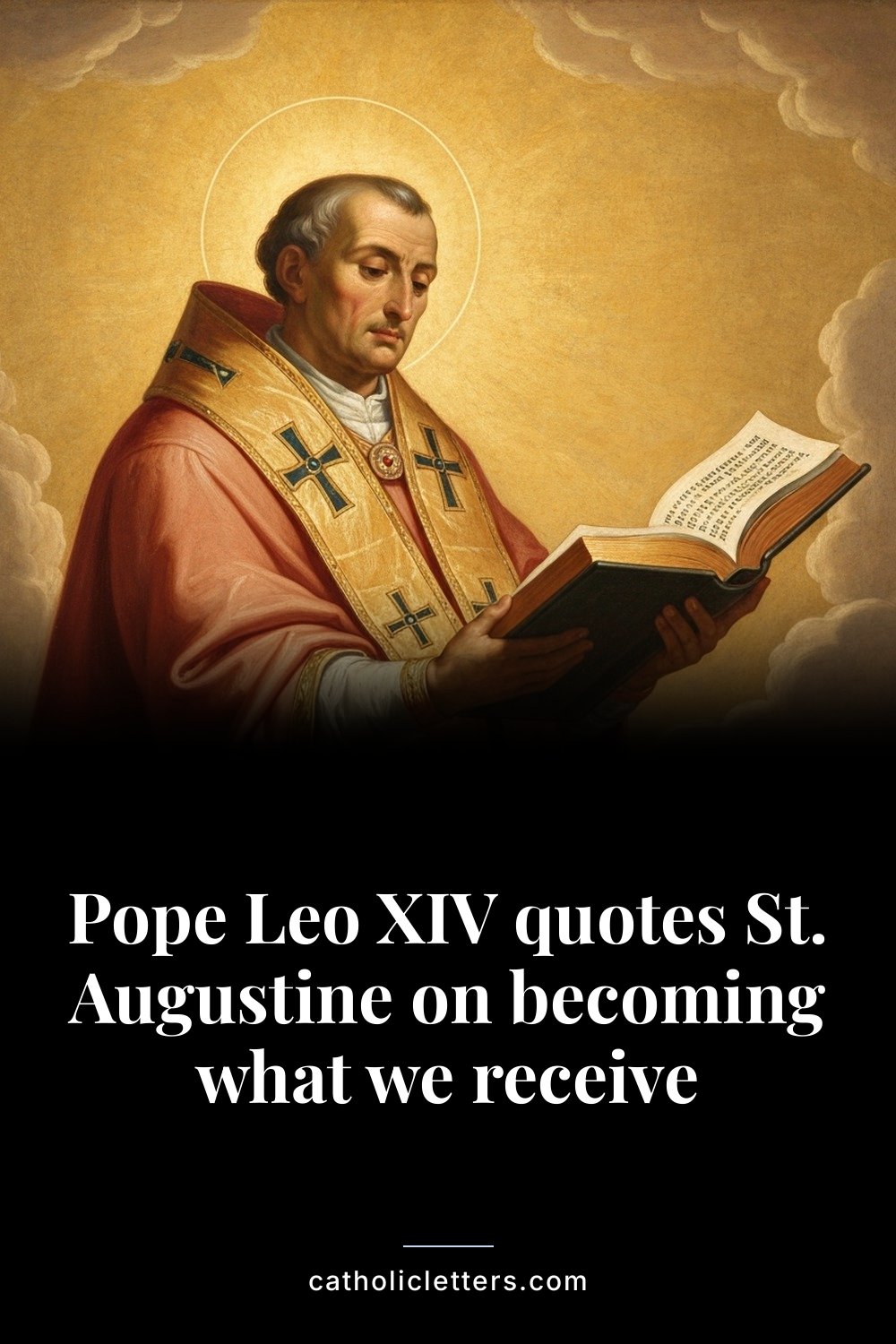
Pope Leo XIV continued his series on Vatican II’s Constitution on the Sacred Liturgy at his June 24 general audience, anchoring his reflection in a line from St. Augustine of Hippo. You can read Aleteia’s coverage for the full context. The Pope’s meditation centered on our participation in the Eucharist as members of Christ’s Body, using one of the Church Fathers’ most quoted lines on the sacrament.
What the Pope said
Pope Leo XIV quoted St. Augustine’s instruction to the newly baptized: “Be what you see, and receive what you are.” The line comes from Augustine’s Sermon 272, preached to neophytes at the Easter Vigil in fifth-century Hippo. Augustine was explaining the consecrated bread and wine on the altar as a sign of the Church herself, the Body of Christ.
The Pope applied Augustine’s teaching to the question of active participation in the liturgy, a core theme of the Second Vatican Council’s document Sacrosanctum Concilium. To participate fully in the Mass is not merely to follow rubrics or sing the hymns, but to become what we receive: the living Body of Christ in the world.
Why this matters
Pope Leo XIV has been slowly working through Sacrosanctum Concilium in his general audiences since early this year, offering a catechesis on the liturgy at a moment when Catholics debate questions of form, language, and reverence. By grounding his reflections in the Fathers rather than modern controversies, the Pope models a pastoral approach: teach the faithful why the Mass matters before arguing over how it should look.
Augustine’s line has been a favorite of popes and theologians for centuries because it collapses the distance between sacrament and mission. You do not receive the Eucharist and then go be holy. You receive the Eucharist and discover you already are what you have received, called to live accordingly.
For Catholic readers
Read Sermon 272 in full if you have never encountered it. It is short, direct, and strikingly modern in tone. Augustine’s sacramental realism is one of the clearest articulations we have of what happens at the altar and what happens to us when we say Amen.
Sources:
1. Aleteia — original report