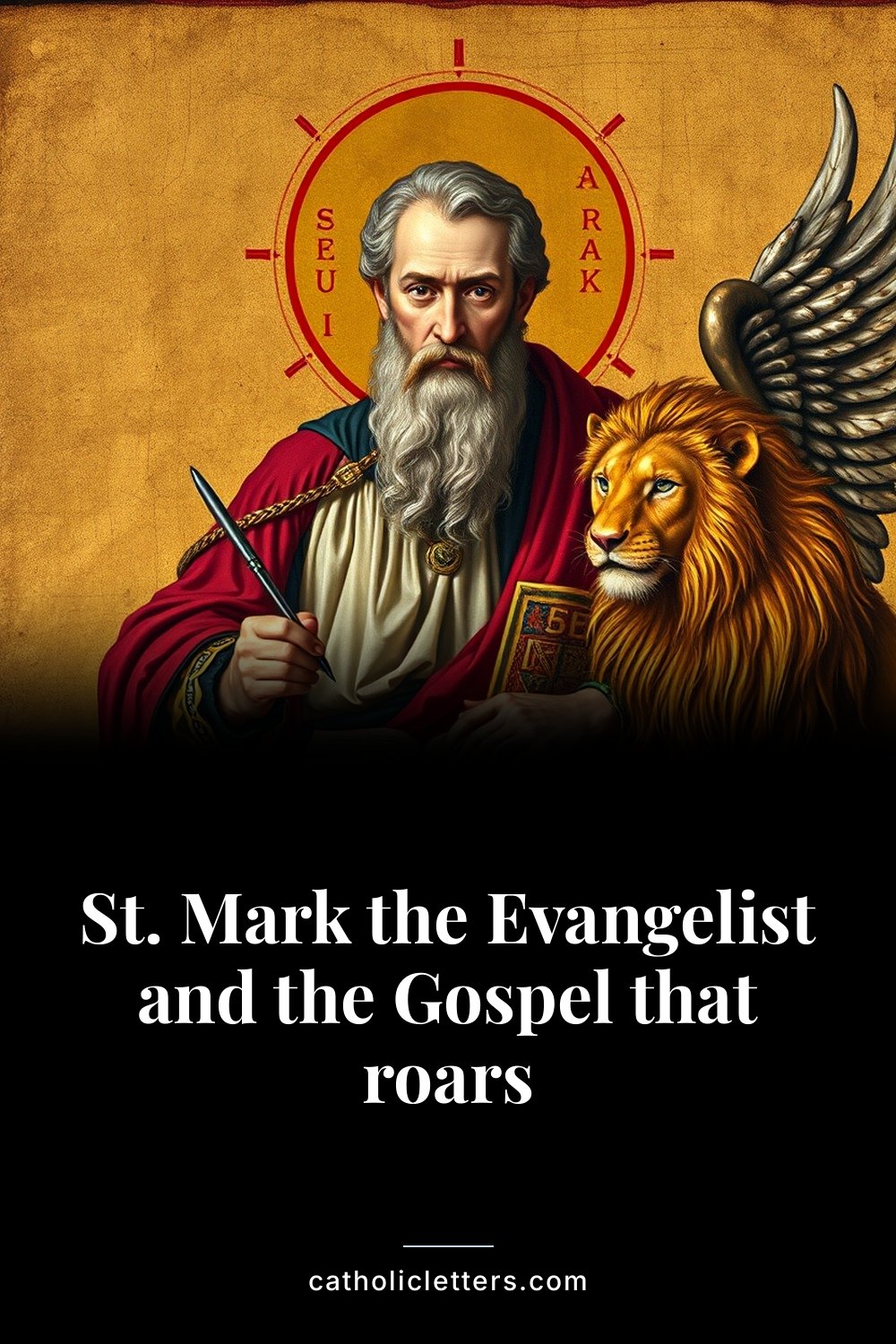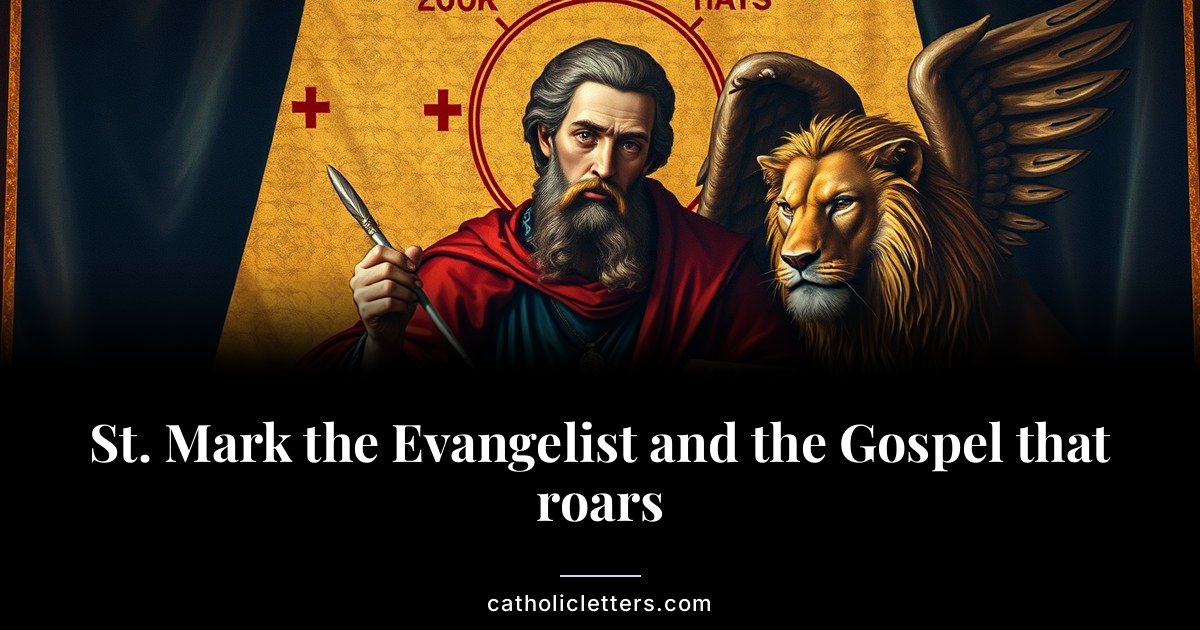
Today is the Feast of St. Mark the Evangelist, author of the shortest and earliest Gospel. If you’ve ever wondered why one evangelist gets a lion while another gets an eagle, or why Mark’s Gospel moves at breakneck speed compared to the others, today’s feast is your chance to meet the man behind the second book of the New Testament.
Who St. Mark was
Mark (also called John Mark) was a first-century Jewish Christian, likely born in Jerusalem around AD 10 and died in Alexandria around AD 68. He was a companion of both St. Peter and St. Paul during their missionary journeys. His mother Mary owned a house in Jerusalem that served as a gathering place for the early Church, the same house where Peter went after his miraculous escape from prison (Acts 12:12).
Mark traveled with Paul and Barnabas (his cousin) on their first missionary journey but turned back early, which caused a sharp disagreement between Paul and Barnabas (Acts 15:37-39). Later, Paul and Mark reconciled, and Paul called him “useful for ministry” (2 Timothy 4:11). Mark is most closely associated with Peter, serving as his interpreter and companion in Rome, where tradition holds he wrote his Gospel based on Peter’s preaching.
What he’s known for
Mark wrote the Gospel of Mark, the shortest of the four canonical Gospels and likely the first to be written, around AD 65-70. His Gospel is immediate, vivid, and action-packed. He uses the word “immediately” over forty times. There are no infancy narratives, no genealogies. Mark begins with Jesus’ baptism and races toward the cross. His Gospel reads like an eyewitness account told at speed, which makes sense if Peter was his primary source.
The winged lion became Mark’s symbol because his Gospel opens with John the Baptist crying out in the wilderness, a voice like a lion’s roar announcing the coming of Christ. In Christian iconography, the lion also represents the resurrection, Christ rising with royal power. Mark’s Gospel ends (in its longer conclusion) with the risen Christ ascending and the disciples going forth to preach everywhere, the Lord working with them.
For today
Read Mark 1:1-15 today, the opening of his Gospel. Notice how fast it moves: creation, prophecy, baptism, temptation, and the Kingdom proclaimed in fifteen verses. Ask yourself: where in my life am I stalling when Christ is saying “immediately”? Mark’s Gospel has no patience for delay. The Kingdom is here. Repent and believe.
Carry that urgency into one thing today.