Today the Church honors Sts. Cyril and Methodius, brothers and missionaries whose work gave the Slavic peoples not just the Gospel but the written language to read it in. Their memorial falls outside Easter Time this year, but their legacy echoes in every Slavic liturgy, every Cyrillic letter, every Church that worships in the vernacular.
Who Cyril and Methodius were
Born in Thessalonica around 827 and 815 respectively, Constantine (he took the name Cyril only near death) and Methodius grew up bilingual in Greek and a Slavic dialect. Methodius served as a provincial governor before entering monastic life. Constantine became a brilliant scholar and librarian at Hagia Sophia in Constantinople. In 862, Prince Rastislav of Great Moravia requested missionaries who could teach the faith in the Slavic tongue. The brothers were sent.
They arrived in Moravia in 863 with a new alphabet. Constantine had invented the Glagolitic script to render Slavic sounds Greek and Latin letters could not capture. They translated the Gospels, the Divine Liturgy, and the psalter. For the first time, Slavic converts heard Scripture in their own language. German bishops protested: only Hebrew, Greek, and Latin were proper for liturgy. The brothers traveled to Rome in 867 to defend their work before Pope Hadrian II, who approved the Slavic liturgy and ordained Methodius a bishop.
Constantine died in Rome in 869, age 42, in monastic habit. Methodius returned to Moravia, endured three years of imprisonment by German bishops, and continued translating and teaching until his death in 885. Their disciples carried the work east and south. The Cyrillic alphabet, named for Cyril though probably developed by his students, became the script of Russian, Bulgarian, Serbian, and Ukrainian.
What they’re known for
Their single most distinctive contribution was insisting that every people has the right to worship God in its own tongue. This was not obvious in the ninth century. Cyril and Methodius believed that translation was incarnational: the Word made flesh for Greeks could be made flesh for Slavs. They wrote the first Slavic legal code, trained native clergy, and defended vernacular liturgy against powerful opposition.
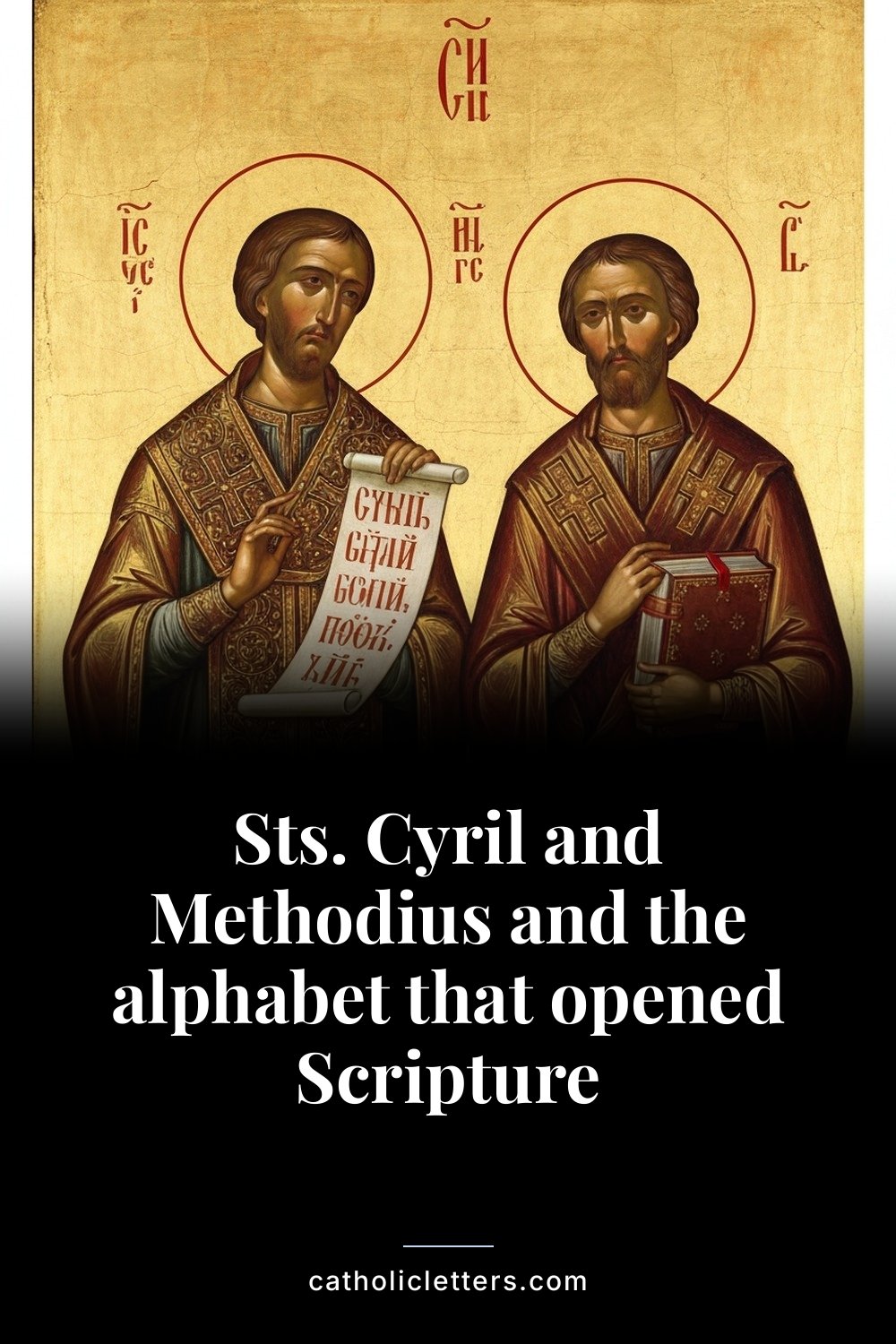
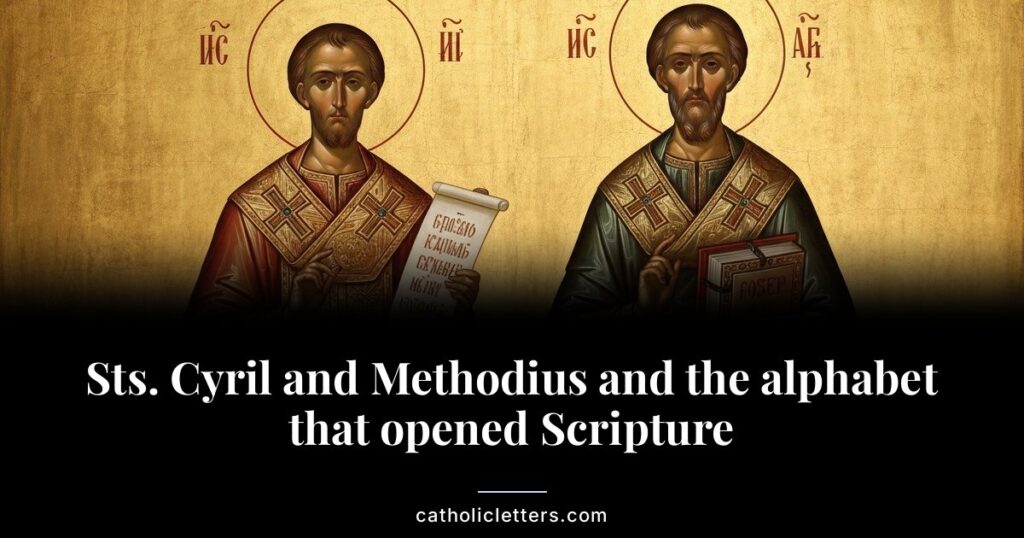
They are depicted in Eastern vestments because Methodius was ordained bishop in the Byzantine rite. The scroll of Cyrillic letters represents not just an alphabet but an entire culture’s access to the written Word. Without their linguistic work, Slavic Christianity would have remained dependent on foreign clergy and foreign tongues.
For today
Read one verse of Scripture today and ask: who gave me this in my language? Someone translated it, someone risked opposition to put it in words you understand. Pray for Bible translators still working in minority languages. Pray for missionaries learning hard languages to bring the Gospel. If you know a second language, read one verse of the Gospel in it. Feel the difference.
Carry gratitude for every translator who made the Word accessible.
Further reading: Saints Cyril and Methodius