Today is the optional memorial of St. Romuald, the 11th-century Italian monk who founded the Camaldolese Benedictines. He spent decades wandering Italy, establishing hermitages where monks could live the solitary life without abandoning the structure of Benedictine community. His spirituality matters in 2026 because it offers a third way between total isolation and constant noise.
Who St. Romuald was
Romuald was born around 951 in Ravenna to a noble family. At twenty, he witnessed his father kill a relative in a duel over property. Horrified, Romuald fled to a nearby Benedictine monastery to do forty days of penance on his father’s behalf. Those forty days became a lifetime. He took the habit and never left monastic life, though he spent most of it outside traditional monastery walls.
He studied under a hermit named Marinus, learning the Desert Fathers’ way of solitude, silence, and the Psalms. For the next seventy years, Romuald traveled across northern Italy, founding hermitages and reforming monasteries. He established his most famous foundation at Camaldoli in Tuscany around 1012, a cluster of individual hermit cells arranged around a church. He died around 1027 at Val di Castro, one of his own hermitages.
What he’s known for
Romuald sought to recover the radical solitude of the early Egyptian Desert Fathers within the structure of Benedictine obedience. Most Western monks lived in large communities with constant interaction. Romuald believed some were called to deeper silence. The Camaldolese model he created allows monks to live alone in separate cells, coming together only for Mass and the Divine Office. Each hermit prays the Psalter alone in his cell, keeps silence, and works with his hands.
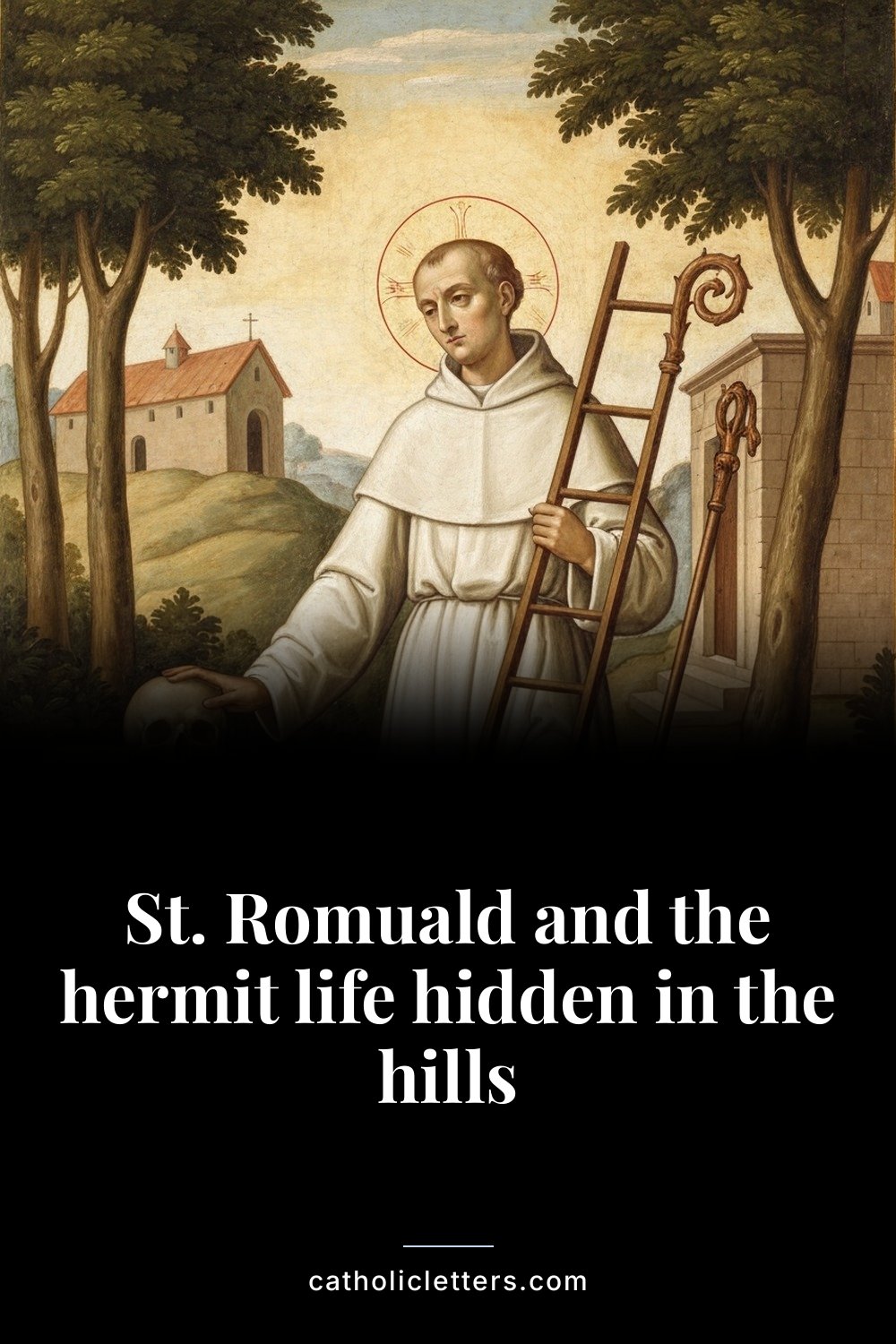
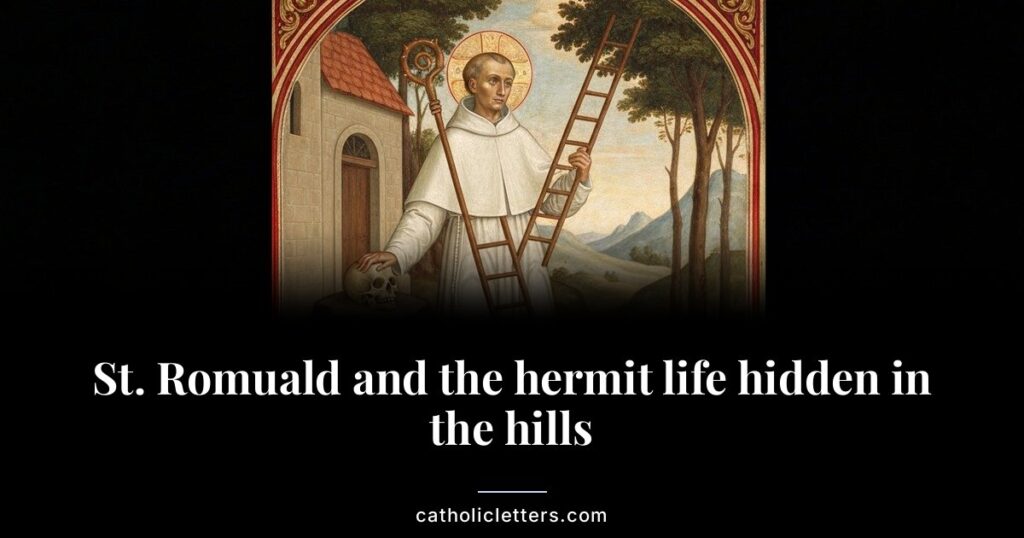
He appears in sacred art wearing the distinctive white habit of the Camaldolese, often with a ladder (symbolizing ascent to God through contemplation) and a skull (reminder of death and the hermit’s focus on eternity). The crosier appears because he briefly served as abbot, though he resigned to return to the hermit life. His teaching was simple: silence, the Psalms, and staying in your cell.
For today
Find ten minutes of complete silence today. Not background music, not a podcast on low volume, not meditation with an app. Actual silence. Sit still. If thoughts come, let them pass like clouds. Romuald’s monks spent hours this way daily. You can manage ten minutes. Try it before bed, or in your car before going inside, or in a church if one is nearby.
Carry the silence with you when it ends.