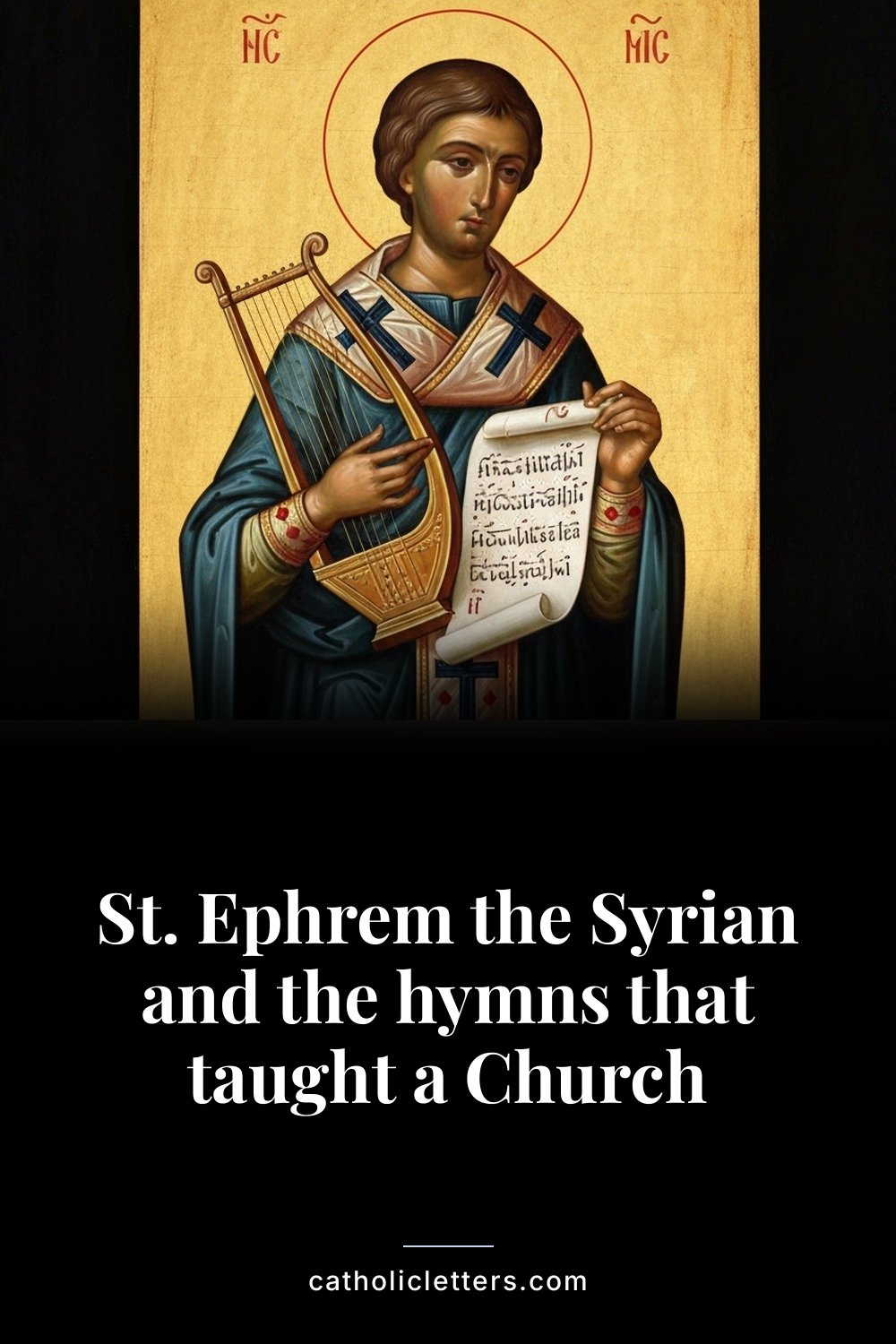
Today’s optional memorial honors St. Ephrem the Syrian, a fourth-century deacon who never gave a homily but taught millions through song. He’s a Doctor of the Church who wrote theology in meter, a poet whose verses were sung in churches before the Nicene Creed was finalized. If you’ve ever learned doctrine through a hymn, you’re walking a path he cleared.
Who St. Ephrem was
Ephrem was born around 306 in Nisibis, in what is now southeastern Turkey, then part of the Roman Empire’s eastern frontier. He lived his entire life in the Syrian-speaking world, writing in Syriac, not Greek or Latin. When Nisibis fell to Persia in 363, he fled to Edessa (modern Urfa, Turkey), where he spent his final decade teaching and writing. He died in 373, probably of plague contracted while caring for the sick.
He was ordained a deacon but never a priest. He taught in Edessa’s theological school, wrote commentaries on Scripture, and composed hundreds of hymns. The Syrian Church called him “the Harp of the Holy Spirit.” Pope Benedict XV named him a Doctor of the Church in 1920, the first Syrian to receive the title.
What he’s known for
Ephrem wrote theology you could sing. In an age when heretics were spreading their teachings through popular songs, Ephrem countered with orthodox hymns set to the same tunes. His madrasha (teaching hymns) and memra (verse homilies) taught the Trinity, the Incarnation, and the Virgin Mary’s role in salvation through rhythm and metaphor. Syrians sang his lines in church before they had written creeds to recite.
He’s shown in icons holding a harp or scroll because music was his medium. The harp isn’t just symbolic. He organized choirs of women to sing his compositions, trusting beauty and melody to lodge truth deeper than argument could. His Marian hymns influenced Eastern devotion for centuries. He called Mary “the pure earth from which Adam was refashioned,” and his imagery still echoes in Orthodox liturgy.
For today
Find a hymn you know by heart and ask what it’s teaching. Not the tune, the words. What doctrine sits inside the lines you’ve memorized without trying? Ephrem trusted that beauty smuggles truth past our defenses. Pick one hymn and speak the words aloud today, slowly, without the music. Let them be theology first, song second.
Carry one line into the rest of the day.