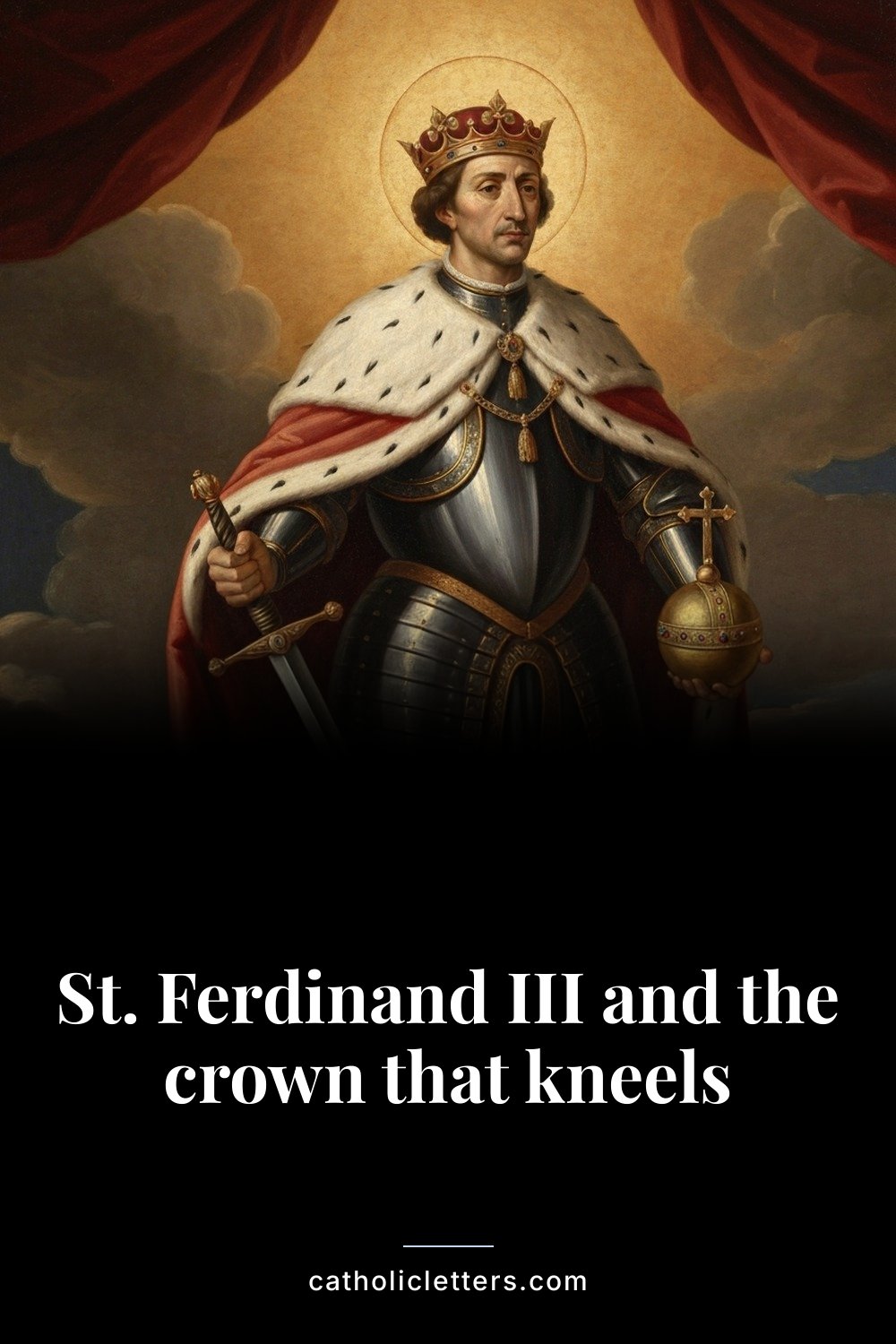
Today the Church offers an optional memorial of St. Ferdinand III, King of Castile and León. He unified medieval Spain, reclaimed Seville from Muslim rule, and died holding a candle and a crucifix. He matters to a 2026 reader because he lived the paradox every Christian with authority must face: how to wield power without worshiping it.
Who St. Ferdinand III was
Fernando was born in 1199 near Salamanca, son of King Alfonso IX of León and Berengaria of Castile. At eighteen he inherited Castile from his mother. At thirty he inherited León from his father, uniting the two kingdoms for the first time. He ruled for thirty-five years, during which he pushed the Reconquista south, recapturing Córdoba in 1236 and Seville in 1248. These were not minor skirmishes. Seville had been a Muslim stronghold for five centuries.
He was a warrior king who attended daily Mass, heard multiple sermons a day, and knew the Psalms by heart. His confessor testified that Ferdinand wept during the Liturgy of the Hours. He was canonized in 1671 by Pope Clement X.
He died on May 30, 1252, in Seville, asking forgiveness from his sons and subjects, lying on a rope bed strewn with ashes. He was fifty-two.
What he’s known for
Ferdinand is remembered for turning mosques into cathedrals. After conquering Seville, he transformed its great mosque into the Cathedral of Seville, later rebuilt as the largest Gothic cathedral in the world. He did not destroy; he consecrated. He saw architecture as belonging ultimately to Christ.
He is patron saint of engineers because he designed siege works, built roads and bridges, and fortified dozens of cities. He combined the strategist’s mind with the penitent’s heart. His sword was always accompanied by the orb and cross. The crown in his iconography sits atop a man who knew he was not the final king.
He founded the University of Salamanca and the Cathedral of Burgos. He left Spain more literate, more unified, and more Catholic than he found it.
For today
Find one place in your life where you hold authority: at work, at home, in a committee, over your own schedule. Ask yourself whether you wield that authority as if it belongs to you or as if it is on loan from God. Ferdinand treated his crown as a temporary trust. Try treating your small sphere of power the same way.
Pray one line from Psalm 72, the psalm for a just king: “Give the king your justice, O God.”
Carry his example through any decision you make today where someone else is depending on you.