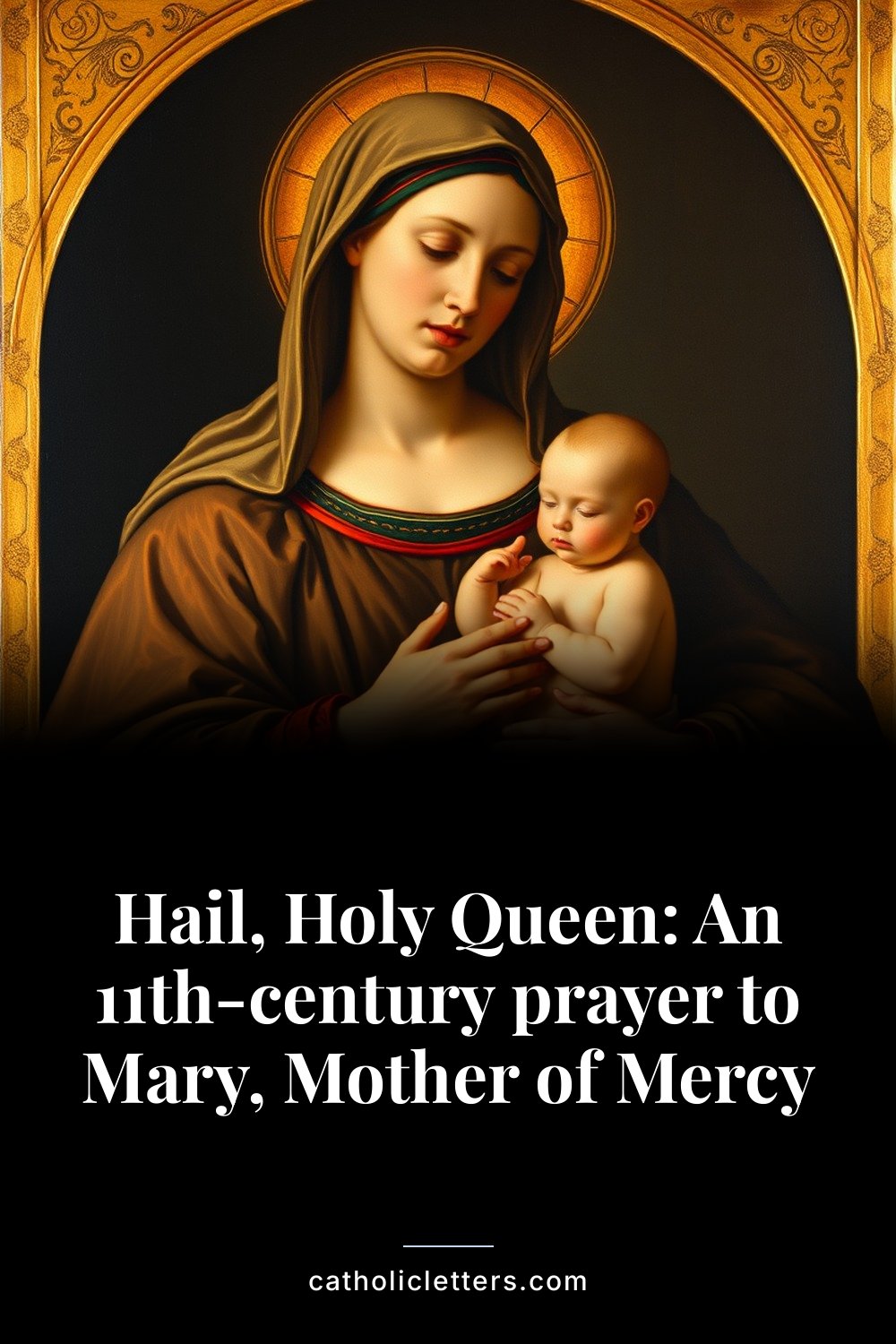
The Salve Regina (Hail, Holy Queen) is one of the Church’s oldest Marian prayers, composed by Hermann of Reichenau in the 11th century. When the day feels like exile, when you’re weary of the valley of tears, this prayer brings your mourning to Mary, the Mother of Mercy, and asks her to turn her eyes of compassion toward you.
Hail, holy Queen, Mother of mercy, our life, our sweetness, and our hope. To thee do we cry, poor banished children of Eve; to thee do we send up our sighs, mourning and weeping in this valley of tears. Turn then, most gracious Advocate, thine eyes of mercy toward us, and after this our exile show unto us the blessed fruit of thy womb, Jesus. O clement, O loving, O sweet Virgin Mary. Pray for us, O holy Mother of God, that we may be made worthy of the promises of Christ.
Hermann of Reichenau, 11th century
How this prayer works
This prayer names what we often feel but struggle to say: we are in exile. The world is a valley of tears. We are poor banished children, sighing and mourning. The Salve Regina does not minimize this. It brings our grief directly to Mary, who knows what it is to stand at the foot of the Cross.
Hermann of Reichenau, the monk who composed this prayer, lived with severe physical disabilities his entire life. He knew exile in his own body. The prayer he left us does not ask Mary to fix our circumstances, but to turn her eyes of mercy toward us in the midst of them, and to show us Jesus, the blessed fruit of her womb, after this exile ends.
Pray this at night, when the day’s burdens settle heavy. Let each title for Mary (Mother of mercy, our life, our sweetness, our hope) rest on your tongue. The prayer ends not with a promise of immediate relief, but with a petition: that we may be made worthy of Christ’s promises. That worthiness comes through mercy, and mercy is what this prayer asks for.
Carry it through this evening.