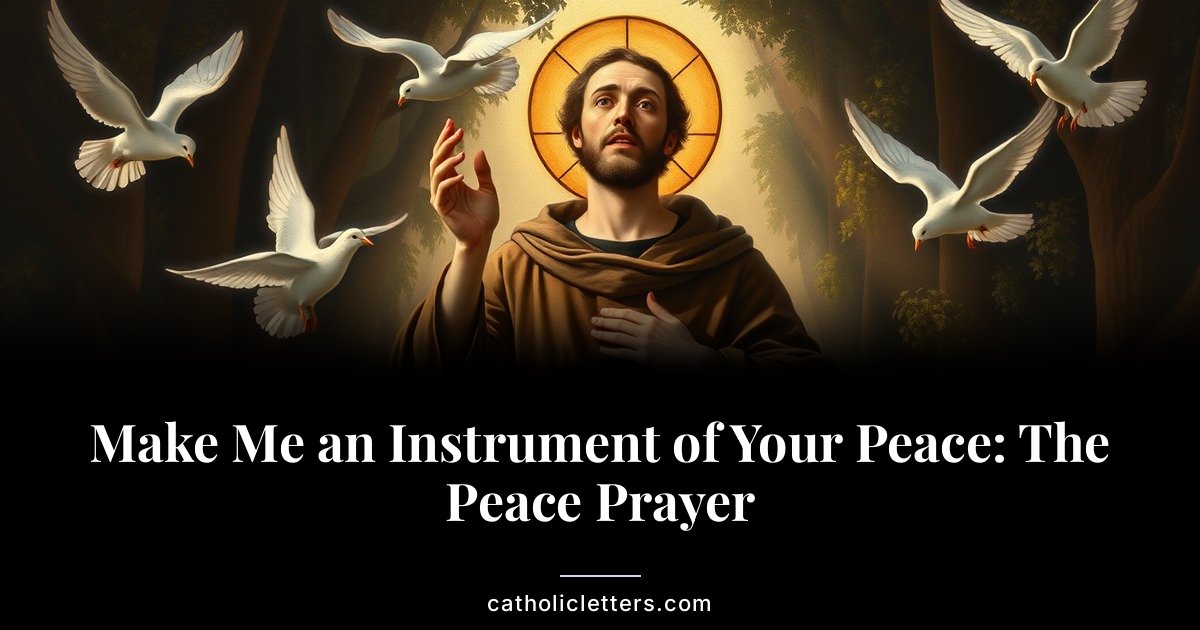
When anger rises in your chest or division opens around you, this prayer offers a different posture. Written anonymously around 1912 and often mistakenly attributed to St. Francis of Assisi, the Peace Prayer asks God to make us instruments—not warriors—of His peace in concrete situations.
Lord, make me an instrument of thy peace. Where there is hatred, let me sow love; where there is injury, pardon; where there is doubt, faith; where there is despair, hope; where there is darkness, light; and where there is sadness, joy. O Divine Master, grant that I may not so much seek to be consoled as to console; to be understood as to understand; to be loved as to love. For it is in giving that we receive; it is in pardoning that we are pardoned; and it is in dying that we are born to eternal life.
Anonymous, c. 1912
How this prayer works
The prayer moves through six antitheses—hatred/love, injury/pardon, doubt/faith, despair/hope, darkness/light, sadness/joy—then pivots to three reversals of natural human instinct: console rather than be consoled, understand rather than be understood, love rather than be loved. Though it first appeared in a French spiritual magazine in 1912, the prayer became associated with St. Francis of Assisi by the mid-20th century due to its Franciscan spirit of self-emptying service.
This is a prayer for ordinary conflict. Pray it before a difficult conversation with a colleague. Pray it when you open social media and feel the pull to argue. Pray it in the car before walking into a tense family dinner. The prayer does not promise that others will become peaceful—it asks that you become an instrument, which means being used, shaped, and sometimes worn down in God’s hands.
The paradoxes at the end are the hardest and the most freeing: we receive by giving, are pardoned by pardoning, are born by dying. These are not metaphors. They describe how grace actually moves through human relationships.
Pray it slowly before your next hard conversation.