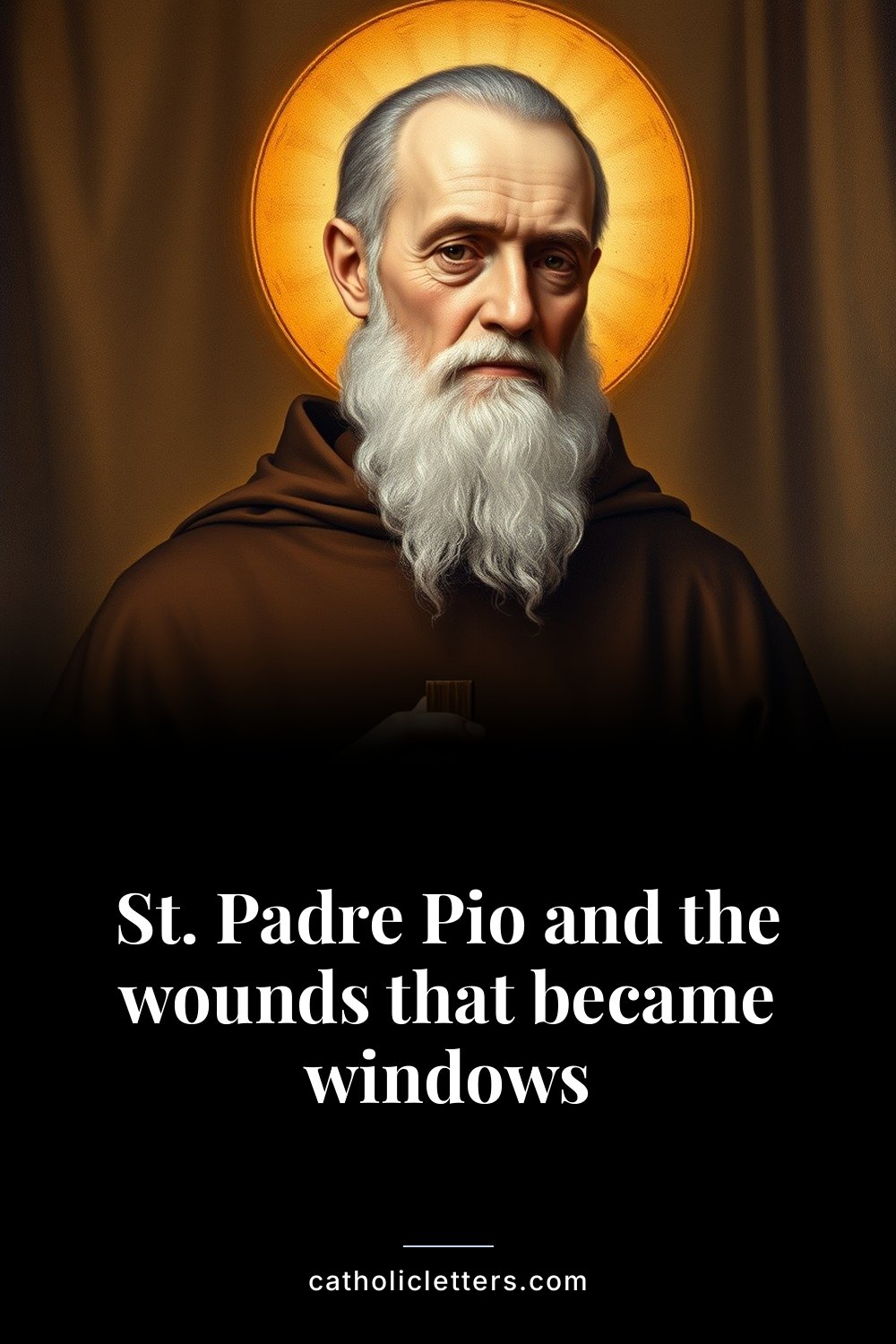
Today’s memorial honors St. Padre Pio, the Capuchin friar who bore the stigmata for fifty years and taught a generation of Catholics that suffering offered to Christ becomes a channel of grace. Born Francesco Forgione in 1887 in rural southern Italy, he died in 1968 after decades as a confessor, mystic, and spiritual father to thousands who sought him out at his friary in San Giovanni Rotondo.
Who St. Padre Pio was
Francesco Forgione entered the Capuchin order at fifteen, taking the name Pio. Ordained in 1910, he spent most of his priesthood at the friary of Our Lady of Grace in San Giovanni Rotondo, a remote town in Puglia. In September 1918, while praying before a crucifix, he received the visible wounds of Christ: nail marks in his hands and feet, and a lance wound in his side. The stigmata remained until his death fifty years later, never infected, medically inexplicable.
His reputation as a confessor drew pilgrims from across Italy and eventually the world. He spent up to sixteen hours a day in the confessional, known for his ability to read souls and for the spiritual direction he gave through letters and brief encounters. His Mass, celebrated slowly with visible absorption in the Passion, often lasted over an hour.
What he’s known for
Padre Pio’s stigmata made him famous, but his real gift was showing people how to unite their own sufferings to Christ’s. He taught that every pain, when offered consciously to God, participates in the redemptive work of the Cross. His letters are full of practical advice on bearing illness, frustration, and spiritual dryness without bitterness.
He founded the Casa Sollievo della Sofferenza (Home for the Relief of Suffering) in 1956, a hospital that treated physical pain while honoring its spiritual dimension. His other enduring devotion was prayer groups, small communities of laypeople committed to daily Rosary and Eucharistic adoration. Thousands of these groups still meet worldwide, following the structure he outlined.
For today
Before you go to sleep tonight, bring to mind one frustration or small pain from your day. Name it specifically. Then say out loud or in your head: “For love of You, Lord, and for the salvation of souls.” That was Padre Pio’s formula. He believed no suffering was wasted if consciously given.
Carry his intercession through the day’s small crosses.