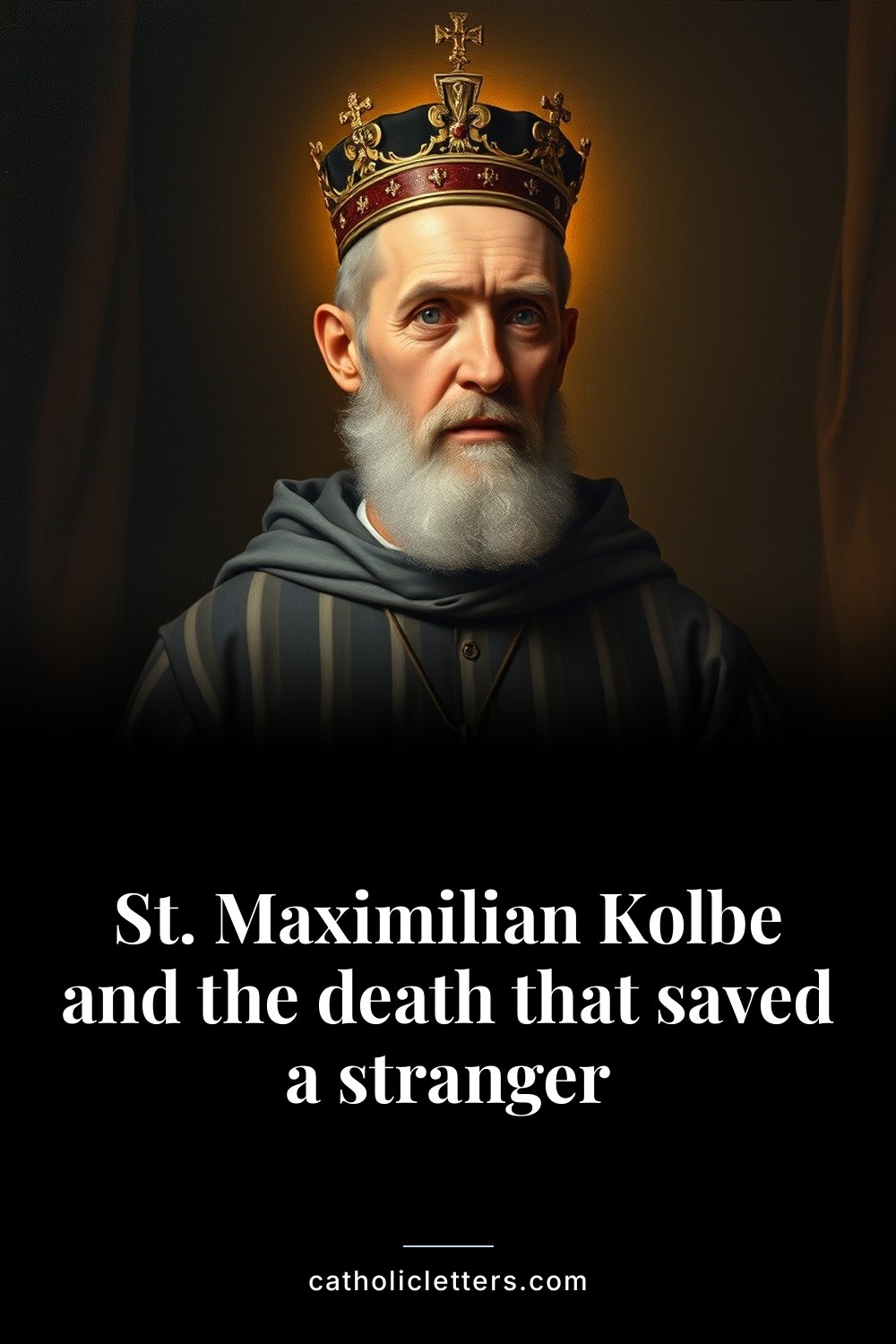
July 19 marks the Memorial of St. Maximilian Kolbe, the Franciscan priest who volunteered to die in place of a fellow prisoner at Auschwitz. In 2026, when the language of sacrifice feels mostly metaphorical, his story is a hard fact: love can triumph even in hell.
Who St. Maximilian Kolbe was
Raymond Kolbe was born in 1894 in Zduńska Wola, Poland, to a poor weaver’s family. At sixteen he entered the Conventual Franciscans, taking the name Maximilian. He was ordained in 1918 after studies in Rome, already marked by tuberculosis that would plague him for life. He founded a Marian movement called the Militia Immaculata and established a massive friary-publishing house near Warsaw that printed millions of copies of devotional magazines. By 1939, his community numbered nearly 800 friars.
The Nazis arrested him in 1941 for sheltering refugees, including Jews. He was sent to Auschwitz as prisoner 16670. In July 1941, after a prisoner escaped from his barracks, the SS selected ten men to die by starvation as reprisal. When one of them, Franciszek Gajowniczek, cried out for his wife and children, Kolbe stepped forward and asked to take his place. The officer agreed. Kolbe spent two weeks in the starvation bunker, leading prayers and hymns, before the guards killed him with a phenol injection on August 14, 1941.
Pope Paul VI beatified him in 1971. Pope John Paul II canonized him in 1982 as a martyr of charity, with Gajowniczek present at the ceremony. Gajowniczek lived until 1995, fifty-four years beyond the death he was spared.
What he’s known for
Kolbe’s spirituality centered on total consecration to Mary. He wore and distributed the Miraculous Medal everywhere, convinced that devotion to the Immaculata was the fastest path to Christ. His crown of red and white in iconography symbolizes the two crowns he saw in a childhood vision: martyrdom and purity. He chose both. The Marian medal appears in almost every image of him because it was inseparable from his identity as a priest and evangelist.
What makes him unforgettable is the simplicity of his final act. No sermons, no grand gestures. Just a middle-aged man with bad lungs, stepping out of line to say: take me instead. The testimony of survivors describes him in the starvation cell as calm, prayerful, and fully present to the men dying beside him. He did not waste his death on despair.
For today
Ask yourself: who in my life needs me to step forward today? Not to die, but to absorb the inconvenience, the criticism, the cost they’re facing. Kolbe’s logic was Marian: make yourself small so someone else can live. Try it in one conversation today. Let someone else have the last word. Take the blame for the thing that wasn’t entirely your fault. Offer your place in line, literal or metaphorical.
St. Maximilian Kolbe, pray for us.