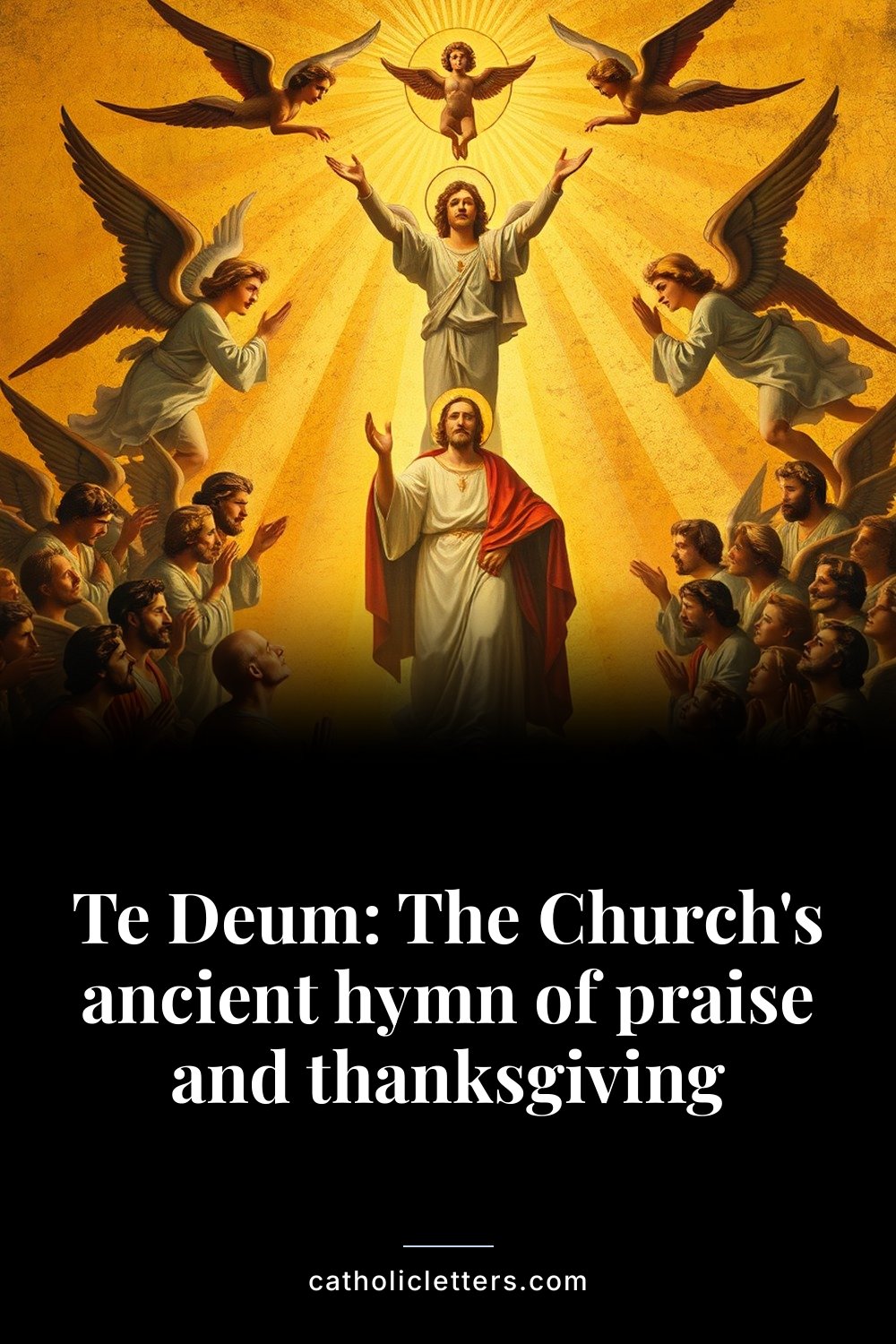
The Te Deum is one of the oldest hymns in Christian liturgy, sung at Morning Prayer, moments of great thanksgiving, and occasions when the Church celebrates divine mercy. Composed in the 4th or 5th century and traditionally attributed to St. Ambrose and St. Augustine, this prayer joins your voice to the angels, apostles, and martyrs who have praised God across the centuries.
We praise thee, O God; we acknowledge thee to be the Lord. All the earth doth worship thee, the Father everlasting. To thee all angels cry aloud, the heavens and all the powers therein. To thee Cherubim and Seraphim continually do cry: Holy, holy, holy, Lord God of Sabaoth; heaven and earth are full of the majesty of thy glory. The glorious company of the apostles praise thee. The goodly fellowship of the prophets praise thee. The noble army of martyrs praise thee. The holy Church throughout all the world doth acknowledge thee, the Father of an infinite majesty, thine honorable, true, and only Son; also the Holy Ghost, the Comforter.
Anonymous, c. 4th-5th century
How this prayer works
The Te Deum does not ask for anything. It simply declares what is true: God is Lord, the angels worship Him without ceasing, and the whole communion of saints acknowledges His majesty. You are praying what the Church has always prayed, adding your voice to a choir that stretches back sixteen centuries.
This hymn is sung after papal elections, at the end of the liturgical year, and whenever the faithful need to remember that praise is the foundation of prayer. It names the Trinity explicitly: Father, Son, and Holy Spirit, each person adored by the angelic hosts and the company of believers.
Pray it aloud today, slowly, letting each line settle. This is not a prayer for speed. You are joining the apostles, the prophets, the martyrs. You are standing with the angels. Carry it into the evening as an act of thanksgiving for the day you have received.