May 22 marks the memorial of St. Thomas Aquinas, the Dominican friar who gave the Church its most systematic theology. Called the Angelic Doctor for the clarity of his mind, Thomas answered the deepest questions about God, creation, and human nature in prose so precise it’s still the foundation of Catholic philosophy. If you’ve ever asked “Why does God allow suffering?” or “How can Jesus be fully God and fully man?”, Thomas built the framework for answering.
Who St. Thomas Aquinas was
Born around 1225 near Aquino, Italy, Thomas was the youngest son of a noble family who expected him to become a Benedictine abbot. At nineteen, he joined the new Dominican order instead. His family kidnapped him and held him under house arrest for a year, even sending a prostitute to tempt him away from religious life. Thomas drove her out with a burning log and never wavered.
He studied in Paris and Cologne under St. Albert the Great, who recognized his genius when other students mocked Thomas for his silence and bulk. Albert said, “We call this young man a dumb ox, but his bellowing in doctrine will one day resound throughout the world.” Thomas taught at Paris, Rome, and Naples, writing ceaselessly until December 6, 1273, when he had a mystical experience during Mass and stopped mid-sentence in the Summa Theologiae. He told his secretary, “All that I have written seems like straw to me.” Three months later, traveling to the Council of Lyon, he died at the Cistercian abbey of Fossanova on March 7, 1274. He was forty-nine.
What he’s known for
Thomas synthesized Aristotelian philosophy with Christian revelation in the Summa Theologiae, a three-part work covering God, man, and Christ in 512 questions and 2,669 articles. Each article follows the same method: state the question, list objections, give the correct answer with reasoning, then respond to each objection. It reads like legal reasoning applied to eternity. He also wrote the Summa Contra Gentiles for missionaries, biblical commentaries, and the hymns Pange Lingua and Tantum Ergo for the feast of Corpus Christi.
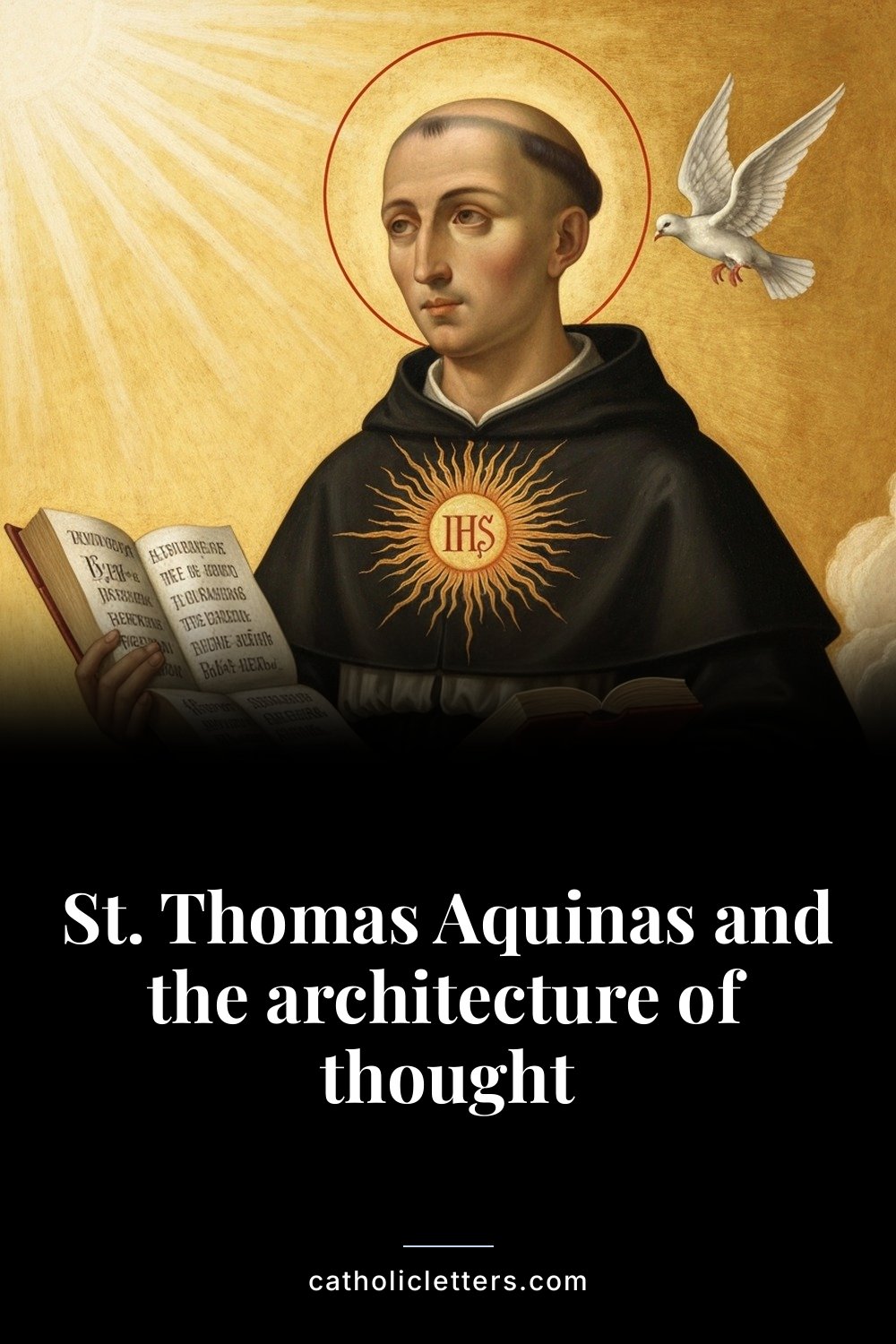
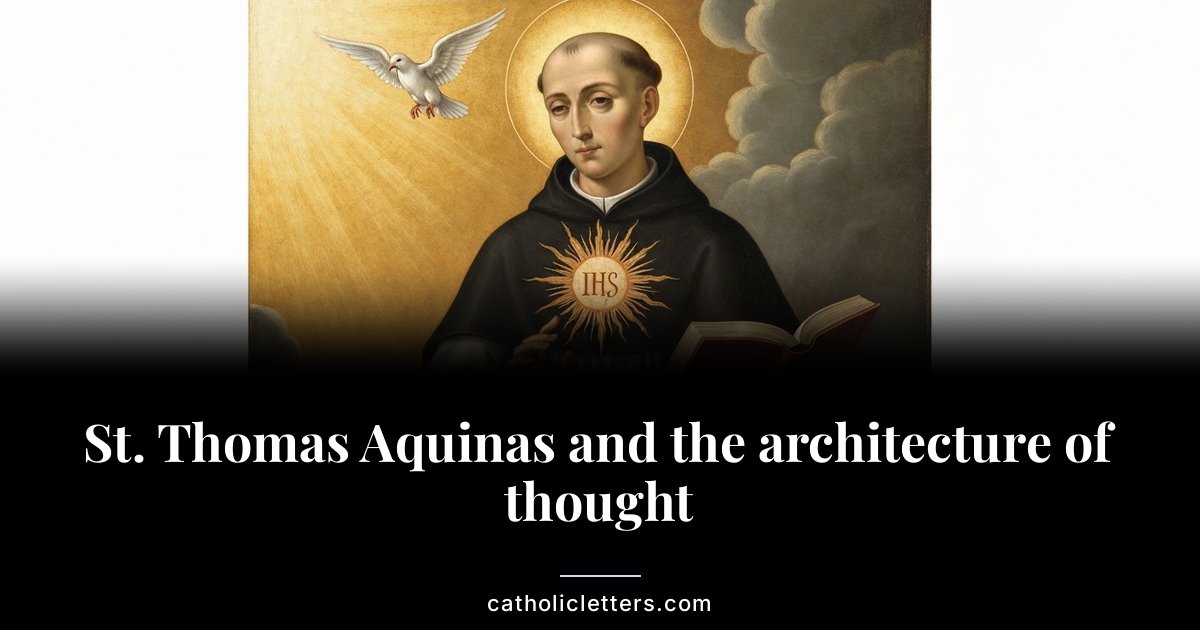
His iconography shows the sun on his chest because his brilliance illuminated theology, often with the IHS monogram representing Christ as the center of all his work. The dove represents the Holy Spirit, which Thomas invoked before every writing session. He’s depicted with a book because he wrote more than eight million words, and in the Dominican black-and-white habit of the Order of Preachers he never left.
For today
Take one question about God you’ve never gotten a straight answer to and look it up in the Summa Theologiae. The New Advent online edition is searchable. Read one article start to finish. Don’t rush. Thomas wrote for people willing to think slowly. Notice how he respects objections before answering them. That’s intellectual humility in motion.
Carry one question through the day.